



About me
I am a postdoctoral researcher in the Department of Astrophysics at the University of Zürich. I previously did my PhD at the Observatoire de la Côte d'Azur, in Nice. I grew up in Boulogne-Billancourt, near Paris.
Research
My research focuses on the internal structures of giant planets. I have developed interior and evolution models of Jupiter, Saturn, Uranus, Neptune and also exoplanets, from hot-Jupiters to sub-Neptunes. Below are some highlights from my work.
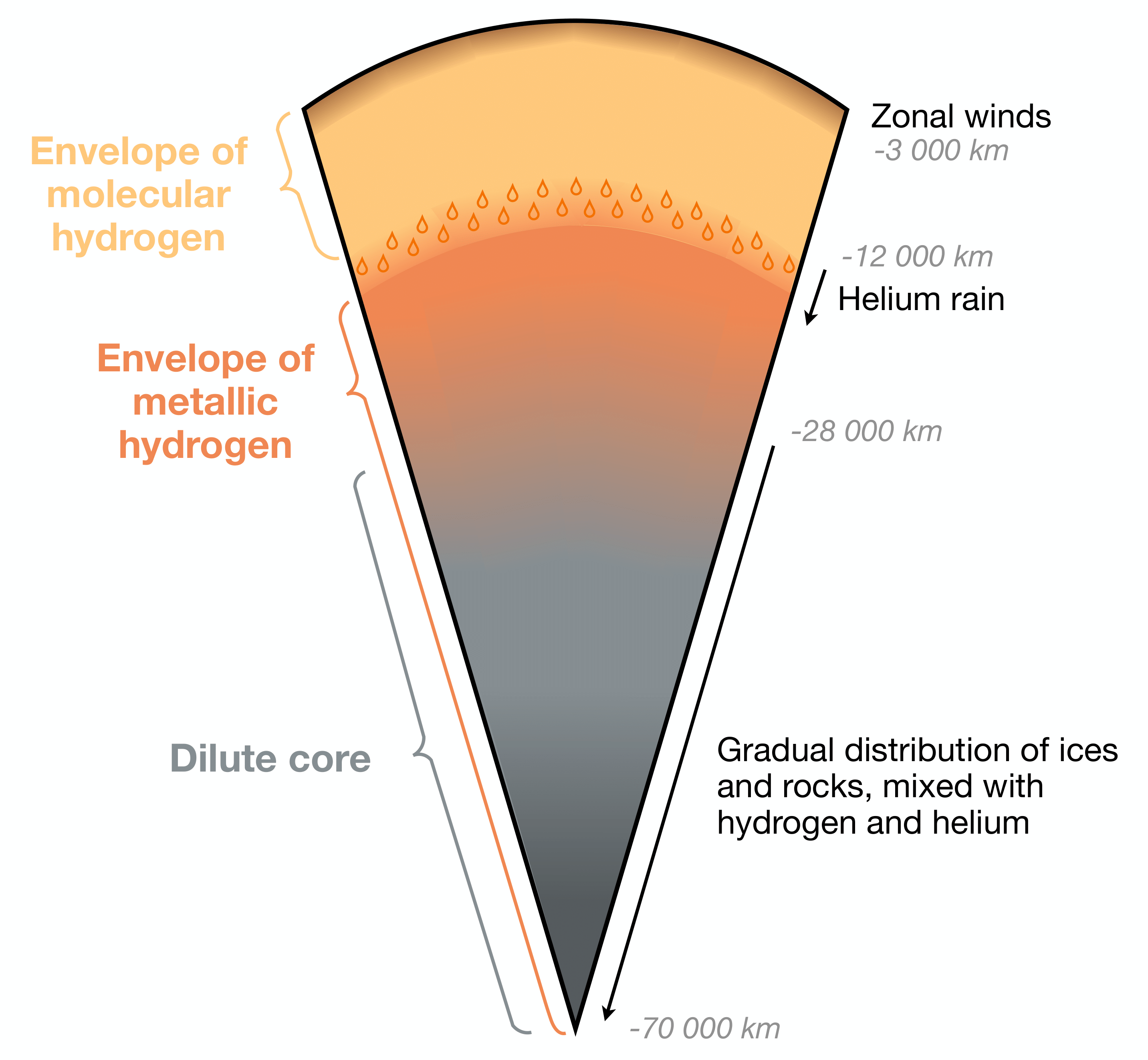
A dilute core inside Jupiter
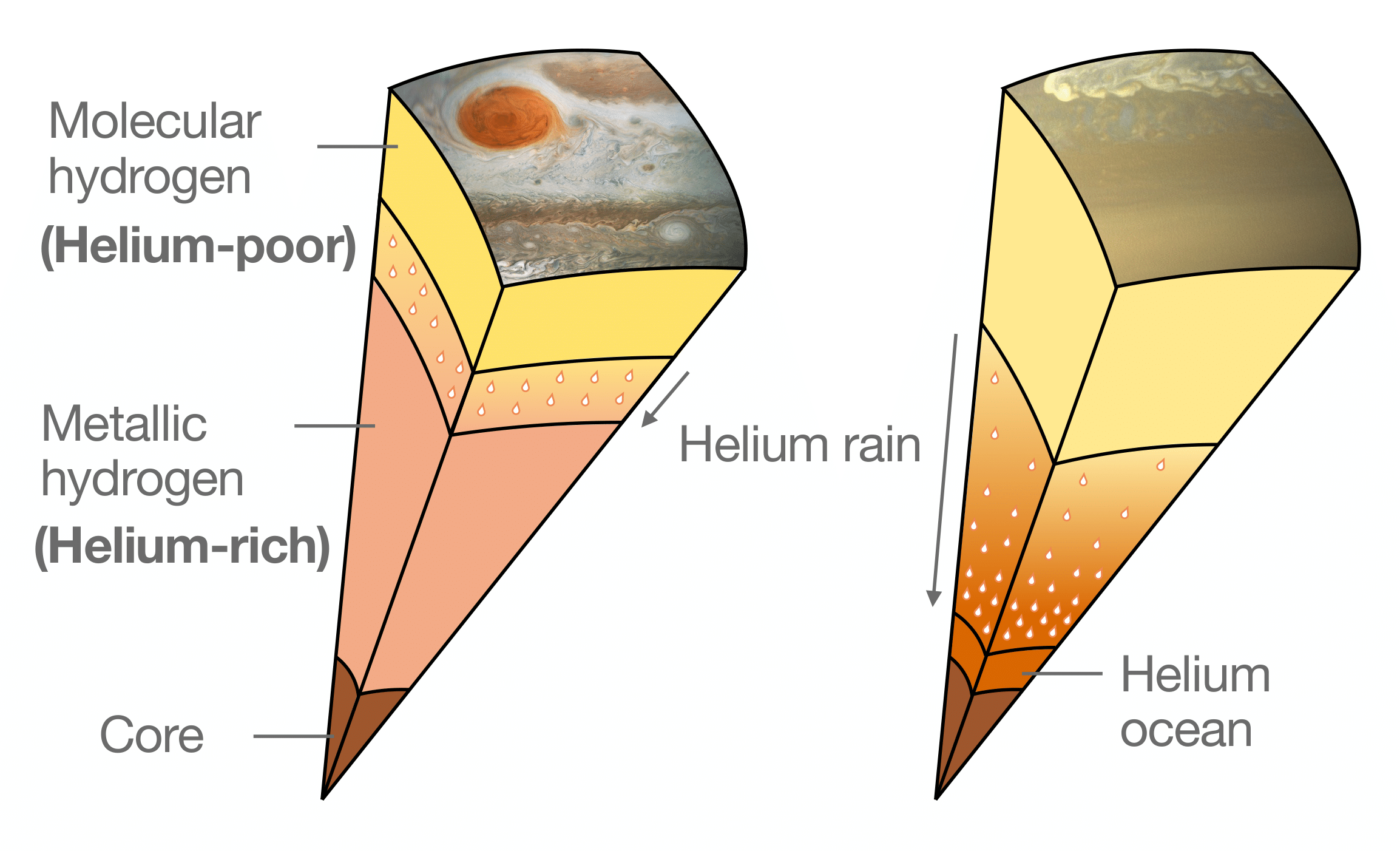
Helium rain in Jupiter and Saturn
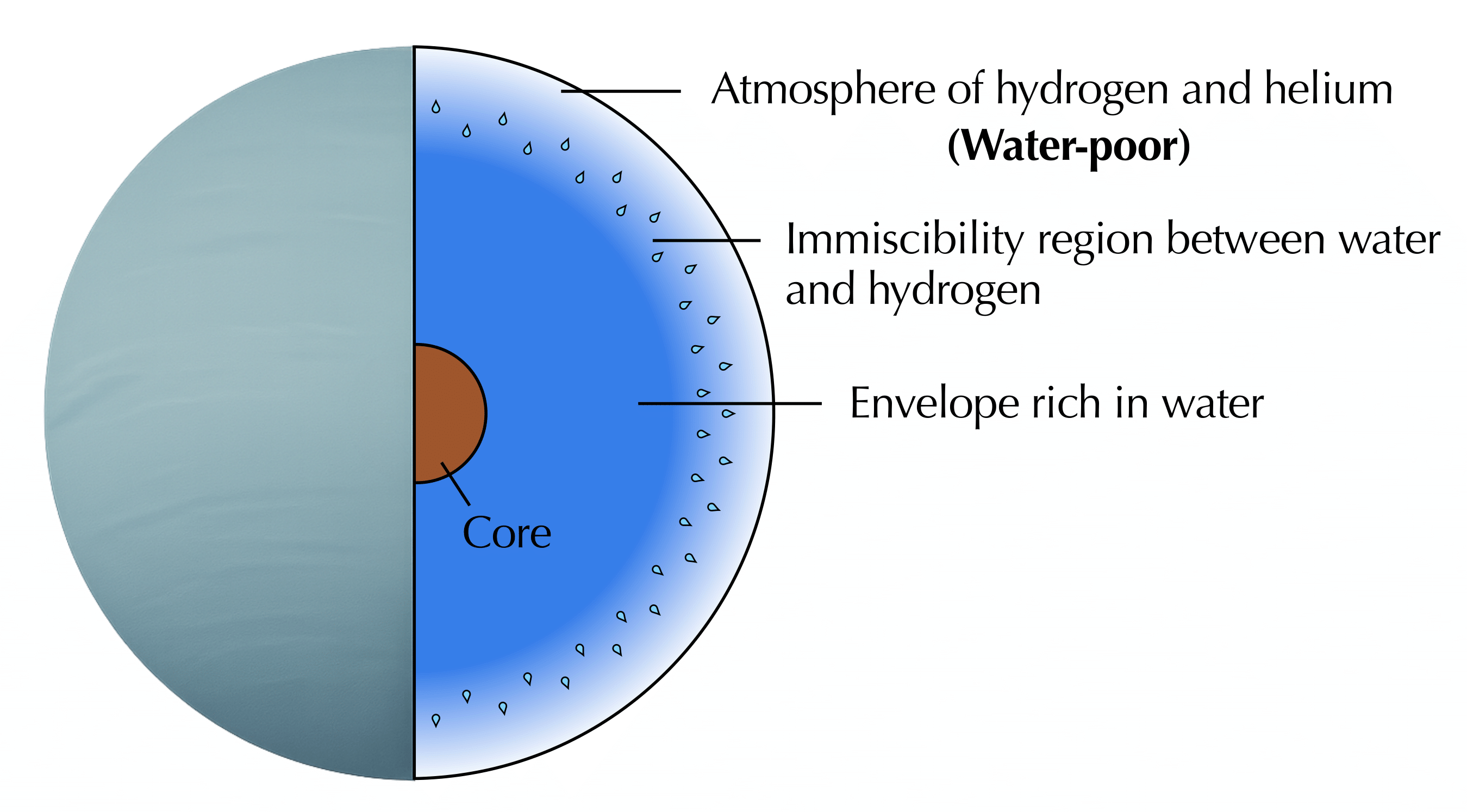
Hydrogen-water demixing in sub-Neptunes
Publications
Here you can find a list of refereed publications that I contributed to:
First author
-
Howard S., Helled R., Müller S., Astronomy & Astrophysics, 2025
Giant exoplanet composition: The impact of the hydrogen-helium equation of state and interior structure [link] -
Howard S., Müller S., Helled R., Astronomy & Astrophysics, 2024
Evolution of Jupiter and Saturn with helium rain [link] -
Howard S., Guillot T., Markham S., Helled R., Müller S., et al., Astronomy & Astrophysics, 2023
Exploring the hypothesis of an inverted Z gradient inside Jupiter [link] -
Howard S., Guillot T., Bazot M., Miguel Y., Stevenson D. J., et al., Astronomy & Astrophysics, 2023
Jupiter's interior from Juno: equation of state uncertainties and dilute core extent [link] -
Howard S. & Guillot T., Astronomy & Astrophysics, 2023
Accounting for non-ideal mixing effects in the hydrogen-helium equation of state [link]
Co-author
-
Ziv M., Galanti E., Howard S., Guillot T., Kaspi Y., et al., Astronomy & Astrophysics, 2024
Characterizing Jupiter’s interior using machine learning reveals four key structures [link] -
Ziv M., Galanti E., Sheffer A., Howard S., Guillot T., et al., Astronomy & Astrophysics, 2024
NeuralCMS: A deep learning approach to study Jupiter’s interior [link] -
Schmider F. X., et al. (Howard S.), The Planetary Science Journal, 2024
Three-dimensional Atmospheric Dynamics of Jupiter from Ground-based Doppler Imaging Spectroscopy in the Visible [link] -
Hobson M., et al. (Howard S.), The Astronomical Journal, 2023
TOI-199b: A well-characterized 100 day transiting warm giant planet with TTVs seen from Antarctica [link] -
Sha L., et al. (Howard S.), Monthly Notices of the Royal Astronomical Society, 2023
TESS spots a mini-neptune interior to a hot saturn in the TOI-2000 system [link] -
Bloot S., Miguel Y., Bazot M., Howard S., Monthly Notices of the Royal Astronomical Society, 2023
Exoplanet interior retrievals: core masses and metallicities from atmospheric abundances [link] -
Korth J., Gandolfi D., Subjak J., Howard S., et al., Astronomy & Astrophysics, 2023
TOI-1130: A photodynamical analysis of a hot Jupiter in resonance with an inner low-mass planet [link] -
Psaridi A., et al. (Howard S.), Astronomy & Astrophysics, 2023
Three Saturn-mass planets transiting F-type stars revealed with TESS and HARPS. TOI-615b, TOI-622b, and TOI-2641b [link] -
Vowell N., et al. (Howard S.), The Astronomical Journal, 2023
HIP 33609b: An eccentric brown dwarf transiting a V = 7.3 rapidly rotating B star [link] -
Trifonov T., et al. (Howard S.), The Astronomical Journal, 2022
TOI-2525b and c: A pair of massive warm giant planets with strong transit timing variations revealed by TESS [link] -
Miguel Y., Bazot M., Guillot T., Howard S., et al., Astronomy & Astrophysics, 2022
Jupiter’s inhomogeneous envelope [link]
A nice review about giant planets
-
Helled R. & Howard S., Chapter for the 'Encyclopedia of Astrophysics'
Giant planet interiors and atmospheres [link]
Conferences
Media
Contact
You can contact me at: saburo.howard@uzh.ch